
 Q. No.
 Product of reaction is :


Which of the following molecules can exhibit optical activity?
1. 1-Bromopropane
2. 2-Bromobutane
3. 3-Bromopentane
4. Bromocyclohexane

The given reaction will be the fastest in which of the following solvents?
CH3 CH2 CH2 Br + NaCN - CH3 CH2 CH2 CN + NaBr
1. Ethanol
2. Methanol
3. N, N'-dimethylformamide (DMF)
4. Water

To unlock all the explanations of this course, you need to be enrolled.
To unlock all the explanations of this course, you need to be enrolled.
Which of the following is the halogen exchange reaction?
| 1. | R X + NaI \(\xrightarrow{\text{ Acetone }}\) RI + NaX |
| 2. | 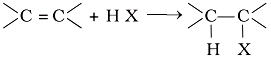 |
| 3. | R - OH + HX \(\xrightarrow{\text{ ZnCl}_2~~}\) R - X + H2O |
| 4. |  |
To unlock all the explanations of this course, you need to be enrolled.
To unlock all the explanations of this course, you need to be enrolled.
3CH3Cl + SbF3 → 3CH3F + SbCl3
The name of the above reaction is:
1. Finkelstein reaction.
2. Sandmeyer's reaction.
3. Gattermann reaction.
4. Swart's reaction.


Identify the reaction given above:
| 1. | Swarts reaction | 2. | Finkelstein reaction |
| 3. | Gattermann reaction | 4. | Sandmeyer's reaction |
| Assertion (A): | The reactivity of alkyl halide for nucleophilic substitution reaction follows the order Rl > RBr > RCl |
| Reason (R): | Leaving ability of halide ions follows the order: I- > Br- > Cl- |
| 1. | Both (A) and (R) are True and (R) is the correct explanation of (A). |
| 2. | Both (A) and (R) are True but (R) is not the correct explanation of (A). |
| 3. | (A) is True but (R) is False. |
| 4. | Both (A) and (R) are False. |
Match the compounds given in Column-I with suitable items given in Column-II:
|
Column-I (Compound) |
Column-II (Uses) |
||
|
A. |
Iodoform |
1. |
Fire extinguisher |
|
B. |
Carbon tetrachloride |
2. |
Insecticide |
|
C. |
CFC |
3. |
Antiseptic |
|
D. |
DDT |
4. |
Refrigerants |
Code
1. A → 2 B → 4 C →1 D →3
2. A → 3 B → 2 C →4 D →1
3. A → 1 B → 2 C →3 D →4
4. A → 3 B → 1 C →4 D →2
Chloroform is slowly oxidized by air in the presence of light and air to form:
1. Phosgene
2. Formyl chloride
3. Formaldehyde
4. Trichloroethanol
To unlock all the explanations of this course, you need to be enrolled.
To unlock all the explanations of this course, you need to be enrolled.

© 2026 GoodEd Technologies Pvt. Ltd.