
 Q. No.
Which of the following diagrams represents the ‘micelle’ formation by amphiphilic molecules in a non polar organic solvent?
1.

2.

3.

4.


According to the International Union of Biochemistry and Molecular Biology, the enzymes belonging to EC 1 are:
| 1. | Oxidoreductases: catalyze oxidation/reduction reactions |
| 2. | Transferases: transfer a functional group (e.g. a methyl or phosphate group) |
| 3. | Hydrolases: catalyze the hydrolysis of various bonds |
| 4. | Lyases: cleave various bonds by means other than hydrolysis and oxidation |

To unlock all the explanations of 38 chapters you need to be enrolled in MasterClass Course.
To unlock all the explanations of 38 chapters you need to be enrolled in MasterClass Course.
Maltose is a disaccharide with two glucose molecules taking part in its formation. The molecular formula of maltose will be:
| 1. | C6H10O5 | 2. | C3H6O3 |
| 3. | C12H24O12 | 4. | C12H22O11 |
To unlock all the explanations of 38 chapters you need to be enrolled in MasterClass Course.
To unlock all the explanations of 38 chapters you need to be enrolled in MasterClass Course.
The number of peptide bonds in a protein molecule made of 120 amino acids will be:
| 1. | 60 | 2. | 119 |
| 3. | 120 | 4. | 240 |
To unlock all the explanations of 38 chapters you need to be enrolled in MasterClass Course.
To unlock all the explanations of 38 chapters you need to be enrolled in MasterClass Course.
Iodine-KI reagent is added to a solution or directly on a potato or other materials such as bread, crackers, or flour. A resultant blue-black color most directly indicates the presence of:
| 1. | Cellulose | 2. | Amylopectin |
| 3. | Amylose | 4. | Sucrose |
In the given graph the curve y shows the presence of an allosteric compound. This compound is acting as a/an:

1. competitive inhibitor.
2. noncompetitive inhibitor.
3. irreversible inhibitor.
4. activator.
In the given diagram showing the tertiary structure of a protein, the disulfide bond is shown by the letter:
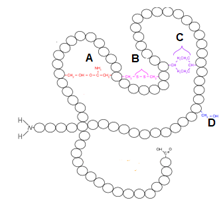
1. A
2. B
3. C
4. D
Consider the given two statements:
| I: | A double-stranded DNA rich in G and C needs more energy to be broken than one that is rich in A and T. |
| II: | While the ratio of G to C and A to T in an organism's DNA is fixed, the GC content can vary considerably from one DNA to another. |
| 1. | Both I and II are correct and II explains I |
| 2. | Both I and II are correct but II does not explain I |
| 3. | I is correct and II is incorrect |
| 4. | Both I and II are incorrect |
In the tertiary structure of a globular protein, where do you expect to find the amino acids serine and alanine?
| 1. | Serine would be in the interior, and alanine would be on the exterior of the globular protein. |
| 2. | Alanine would be in the interior, and serine would be on the exterior of the globular protein. |
| 3. | Both serine and alanine would be in the interior of the globular protein. |
| 4. | Both serine and alanine would be on the exterior of the globular protein. |
The number of water molecules needed to hydrolyze a polymer made of 51 monomers will be:
| 1. 1 | 2. 25 |
| 3. 50 | 4. 51 |

© 2026 GoodEd Technologies Pvt. Ltd.