In Young's-double slit experiment, the distance between the slits and the screen is doubled. The separation between the slits is reduced to half. As a result the fringe width:
| 1. | is halved |
| 2. | become four times |
| 3. | remains unchanged |
| 4. | is doubled |


Subtopic: Young's Double Slit Experiment |
80%
Level 1: 80%+
NEET - 2013
Hints

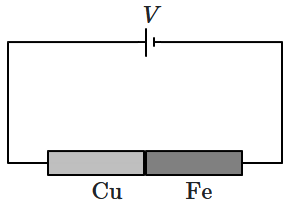
Two rods of equal length \(1~\text{m}\) and equal cross-sectional area \(0.01~\text{cm}^2\) are joined in series, as shown. One rod is copper with resistivity \(1.7\times10^{-6}~\Omega\text{-cm},\) and the other is iron with resistivity \(10^{-5}~\Omega\text-\text{cm}.\) What voltage must be applied across the combination to maintain a current of \(1~\text A\) in the circuit?
| 1. | \(0.00145~\text V\) | 2. | \(0.0145~\text V\) |
| 3. | \(1.7\times10^{-6}~\text V\) | 4. | \(0.117~\text V\) |
Subtopic: Derivation of Ohm's Law |
64%
Level 2: 60%+
NEET - 2013
Hints
A long straight wire carries a certain current and produces a magnetic field \(2 \times 10^{-4} ~\text{Wb/m}^2\) at a perpendicular distance of \(5~\text{cm}\) from the wire. An electron situated at \(5~\text{cm}\) from the wire moves with a velocity \(10^7 ~\text{m/s}\) towards the wire along perpendicular to it. The force experienced by the electron will be:
(The charge on electron = \(1.6 \times 10^{-19} ~\text C\) )
(The charge on electron = \(1.6 \times 10^{-19} ~\text C\) )
| 1. | \(3.2~\text N\) | 2. | \(3.2 \times 10^{-16} ~\text N\) |
| 3. | \(1.6 \times 10^{-16} ~\text N\) | 4. | zero |
Subtopic: Lorentz Force |
75%
Level 2: 60%+
NEET - 2013
Hints
The output from a \(\mathrm{NAND}\) gate is divided into two in parallel and fed to another \(\mathrm{NAND}\) gate. The resulting gate is a:

1. \(\mathrm{AND}\) gate
2. \(\mathrm{NOR}\) gate
3. \(\mathrm{OR}\) gate
4. \(\mathrm{NOT}\) gate
1. \(\mathrm{AND}\) gate
2. \(\mathrm{NOR}\) gate
3. \(\mathrm{OR}\) gate
4. \(\mathrm{NOT}\) gate
Subtopic: Logic gates |
78%
Level 2: 60%+
NEET - 2013
Hints
The ratio of radii of gyration of a circular ring and a circular disc, of the same mass and radius, about an axis passing through their centres and perpendicular to their planes are:
1. \(1 : \sqrt 2\)
2. \(3:2\)
3. \(2:1\)
4. \( \sqrt 2 : 1 \)
1. \(1 : \sqrt 2\)
2. \(3:2\)
3. \(2:1\)
4. \( \sqrt 2 : 1 \)
Subtopic: Moment of Inertia |
77%
Level 2: 60%+
NEET - 2013
Hints
The pair of quantities having the same dimensions are:
| 1. | impulse and surface tension |
| 2. | angular momentum and work |
| 3. | work and torque |
| 4. | Young's modulus and energy |
Subtopic: Dimensions |
82%
Level 1: 80%+
NEET - 2013
Hints
A system is taken from state \(a\) to state \(c\) by two paths \(adc\) and \(abc\) as shown in the figure. The internal energy at \(a\) is \({U}_{a}=10~\text{J}.\) Along the path \(adc\) the amount of heat absorbed \(\delta Q_1=50~\text{J}\) and the work obtained \(\delta W_1=20~\text{J}\) whereas along the path \(abc\) the heat absorbed \(\delta Q_2 = 36~\text{J}.\) The amount of work along the path \(abc\) is:

| 1. | \(10~\text{J}\) | 2. | \(12~\text{J}\) |
| 3. | \(36~\text{J}\) | 4. | \(6~\text{J}\) |
Subtopic: First Law of Thermodynamics |
78%
Level 2: 60%+
NEET - 2013
Hints
The primary coil of a transformer, when connected to a \(10~\text{V}\text-\)DC battery, draws a current of \(1~\text{mA}.\) The number of turns in the primary and secondary coils are \(50\) and \(100,\) respectively. The voltage across the secondary coil and the current drawn by the circuit in the secondary are respectively:
| 1. | \(20~\text{V}\) and \(2.0~\text{mA}\) |
| 2. | \(10~\text{V}\) and \(0.5~\text{mA}\) |
| 3. | zero and therefore no current |
| 4. | \(20~\text{V}\) and \(0.5~\text{mA}\) |
Subtopic: Transformer |
Level 3: 35%-60%
NEET - 2013
Hints
How does the binding energy per nucleon vary with the increase in the number of nucleons?
| 1. | decrease continuously with mass number. |
| 2. | first decreases and then increases with an increase in mass number. |
| 3. | first increases and then decreases with an increase in mass number. |
| 4. | increases continuously with mass number. |
Subtopic: Nuclear Binding Energy |
81%
Level 1: 80%+
NEET - 2013
Hints

Unlock IMPORTANT QUESTION
This question was bookmarked by 5 NEET 2025 toppers during their NEETprep journey. Get Target Batch to see this question.
✨ Perfect for quick revision & accuracy boost
Buy Target Batch
Access all premium questions instantly
The length of a wire between the two ends of a sonometer is \(100~\text{cm}.\) What should be the positions of two bridges below the wire so that the three segments of the wire have their fundamental frequencies in the ratio \(1:3:5\)?
| 1. | \(\dfrac{1500}{23} \mathrm{~cm}, \dfrac{500}{23} \mathrm{~cm} \) |
| 2. | \(\dfrac{1500}{23} \mathrm{~cm}, \dfrac{300}{23} \mathrm{~cm} \) |
| 3. | \(\dfrac{300}{23} \mathrm{~cm}, \dfrac{1500}{23} \mathrm{~cm} \) |
| 4. | \(\dfrac{1500}{23} \mathrm{~cm}, \dfrac{2000}{23} \mathrm{~cm}\) |
Subtopic: Standing Waves |
Level 3: 35%-60%
NEET - 2013
Hints

© 2026 GoodEd Technologies Pvt. Ltd.