- 1(current)
 Q. No.
Suppose we consider a large number of containers each containing initially 10000 atoms of a radioactive material with a half life of 1 year. After 1 year,
1. all the containers will have 5000 atoms of the material.
2. all the containers will contain the same number of atoms of the material but that number will only be approximately 5000.
3. the containers will in general have different numbers of the atoms of the material but their average will be close to 5000.
4. none of the containers can have more than 5000 atoms.
1. all the containers will have 5000 atoms of the material.
2. all the containers will contain the same number of atoms of the material but that number will only be approximately 5000.
3. the containers will in general have different numbers of the atoms of the material but their average will be close to 5000.
4. none of the containers can have more than 5000 atoms.


Level 3: 35%-60%
Please attempt this question first.
Hints

Samples of two radioactive nuclides A and B are taken. λA and λB are the disintegration constants of A and B respectively. In which of the following cases, the two samples can simultaneously have the same decay rate at any time?
a. Initial rate of decay of A is twice the initial rate of decay of B and λA = λB.
b. Initial rate of decay of A is twice the initial rate of decay of B and λA > λB.
c. Initial rate of decay of B is twice the initial rate of decay of A and λA > λB.
d. Initial rate of decay of B is same as the rate of decay of A at t = 2h and λB < λA
Choose the correct option:
1. (a), (b), (c)
2. (b), (d)
3. (a), (d)
4. (b), (c)
a. Initial rate of decay of A is twice the initial rate of decay of B and λA = λB.
b. Initial rate of decay of A is twice the initial rate of decay of B and λA > λB.
c. Initial rate of decay of B is twice the initial rate of decay of A and λA > λB.
d. Initial rate of decay of B is same as the rate of decay of A at t = 2h and λB < λA
Choose the correct option:
1. (a), (b), (c)
2. (b), (d)
3. (a), (d)
4. (b), (c)
68%
Level 2: 60%+
Please attempt this question first.
Hints
The variation of decay rate of two radioactive samples A and B with time is shown in Fig. 13.1. Which of the following statements are true?
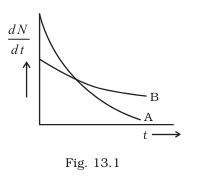
a. Decay constant of A is greater than that of B, hence A always decays faster than B.
b. Decay constant of B is greater than that of A but its decay rate is always smaller than that of A.
c. Decay constant of A is greater than that of B but it does not always decay faster than B.
d. Decay constant of B is smaller than that of A but still its decay rate becomes equal to that of A at a later instant.
Choose the correct option:
1. (a), (b), (c)
2. (c), (d)
3. (a), (d)
4. (b), (c)
a. Decay constant of A is greater than that of B, hence A always decays faster than B.
b. Decay constant of B is greater than that of A but its decay rate is always smaller than that of A.
c. Decay constant of A is greater than that of B but it does not always decay faster than B.
d. Decay constant of B is smaller than that of A but still its decay rate becomes equal to that of A at a later instant.
Choose the correct option:
1. (a), (b), (c)
2. (c), (d)
3. (a), (d)
4. (b), (c)
63%
Level 2: 60%+
Please attempt this question first.
Hints
- 1(current)
Q. No.
© 2026 GoodEd Technologies Pvt. Ltd.