
 Q. No.
What limitation of traditional hybridization used for plant and animal breeding has been overcome by
the use of rDNA techniques?
1. High cost
2. Insertion of undesirable genes
3. Complexity of the procedure
4. Antigenicity of the product


What is true A,B and C in the given diagrammatic representation of rDNA technology ?
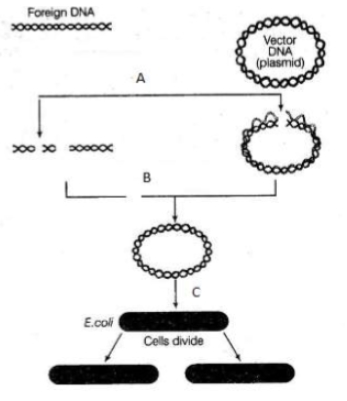
| I: | At A same restriction enzyme is used to cut both foreign and vector DNA |
| II: | The enzyme used at B is DNA ligase |
| III: | Step C can be called as transformation |
| 1. | I and II only |
| 2. | I and III only |
| 3. | II and III only |
| 4. | I,II and III |
The cutting of DNA at specific locations became possible with the discovery of
1. restriction enzymes
2. probes
3. selectable markets
4. ligases
Introduction of foreign genes for improving phenotype is
1. biotechnology
2. vernalization
3. tissue culture
4. genetic engineering
In 1960’s two enzymes were discovered in bacteria that were responsible for providing immunity against bacteriophages. One was Restriction Endonuclease and the other was
1. Methylase
2. Exonuclease
3. Aminotransferase
4. Terminal Transferase
The definition of biotechnology given by EFB encompasses
| 1. | Traditional view |
| 2. | Modern molecular biotechnology |
| 3. | Both 1 and 2 |
| 4. | Only Molecular analogs |
Which of the following is not a core technique which gave birth to modern biotechnology?
1. Genetic engineering
2. Bioprocess engineering
3. Fermentation
4. Both 1 and 2

Variations which are the results of sexual reproduction will
| 1. | Always bad for a population |
| 2. | Not always good for individual but for population |
| 3. | Not always good for individual and population |
| 4. | Always good for individual |
If you transform a cell with an alien piece of DNA only, What is the possibility?
1. This alien piece becomes a part of the host genome.
2. It doesn't become a part of the host's genome but keeps on replicating
3. The cloning of genes won't get affected in the absence of Origin of replication.
4. Multiple identical copies of an alien piece of DNA can be formed irrespective of its integration into the host's genome.
Cohen and Boyer are known for which of the following discoveries?
| 1. | Antibiotic resistance gene |
| 2. | Recombinant DNA |
| 3. | Restriction Digestion |
| 4. | Plasmid |

© 2026 GoodEd Technologies Pvt. Ltd.