
 Q. No.
Genes are packaged into a bacterial chromosome by [1997]
1. Histones
2. Basic proteins
3. Acidic proteins
4. Actin


What is the term used for a protein molecule that assists in the proper folding of other proteins?
1. ubiquitin
2. chaperonin
3. vimentins
4. cyclins
Study the primary structure of a part of a hypothetical protein and choose the correct statements:

| I: | 1 is Serine |
| II: | 2 is sulfur containing amino acid and can be methionine |
| III: | 3 is aromatic amino acid and can by tyrosine |
| IV: | 4 is an acidic amino acid |
2. I, III and IV only
3. II, III and IV only
4. I, II, III and IV
Which one is the most abundant protein in the animal world?
1. Trypsin
2. Haemoglobin
3. Collagen
4. Insulin
Proteins are
| 1. | homopolymer |
| 2. | heteropolymer |
| 3. | homogenous mixture of amino acids |
| 4. | heterogenous mixture of amino acids |
Which of the following glucose transporters is insulin-dependent?
1. GLUT IV
2. GLUT I
3. GLUT II
4. GLUT III
What would be true for the structure of a biomolecule shown below?
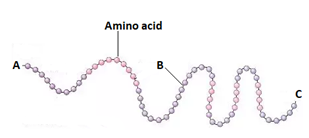
1. It shows the primary structure of a polypeptide where A is the C-terminus; B is the peptide bond and C is the N-terminus.
2. It shows the secondary structure of a polypeptide where A is the C-terminus; B is the peptide bond and C is the N-terminus.
3. It shows the primary structure of a polypeptide where A is the N-terminus; B is the peptide bond and C is the C-terminus.
4. It shows the secondary structure of a polypeptide where A is the C-terminus; B is the N-glycosidic bond andzC is the N-terminus.
Match the following:
| (a) | Inhibitor of catalytic activity of succinate dehydrogenase | (i) | Ricin |
| (b) | Possess peptide bonds | (ii) | Malonate |
| (c) | Cell wall material in fungi | (iii) | Chitin |
| (d) | Secondary metabolite | (iv) | Collagen |
Choose the correct option from the following:
| (a) | (b) | (c) | (d) | |
| 1. | (iii) | (i) | (iv) | (ii) |
| 2. | (iii) | (iv) | (i) | (ii) |
| 3. | (ii) | (iii) | (i) | (iv) |
| 4. | (ii) | (iv) | (iii) | (i) |
Match the following:
| Column-I | Column-II | ||
| (a) | Aquaporin | (i) | Amide |
| (b) | Asparagine | (ii) | Polysaccharide |
| (c) | Abscisic acid | (iii) | Polypeptide |
| (d) | Chitin | (iv) | Carotenoids |
| Options: | (a) | (b) | (c) | (d) |
| 1. | (iii) | (i) | (iv) | (ii) |
| 2. | (ii) | (iii) | (iv) | (i) |
| 3. | (ii) | (i) | (iv) | (iii) |
| 4. | (iii) | (i) | (ii) | (iv) |
Match List-I with List-II.
| List-I | List-II | ||
| (a) | Protein | I. | C-C double bonds |
| (b) | Unsaturated fatty acid | II. | Phosphodiester bonds |
| (c) | Nucleic acid | III. | Glycosidic bonds |
| (d) | Polysaccharides | IV. | Peptide bonds |
Choose the correct answer from the options given below:
| Options: | (a) | (b) | (c) | (d) |
| 1. | II | I | IV | III |
| 2. | IV | III | I | II |
| 3. | IV | I | II | III |
| 4. | I | IV | III | II |

© 2026 GoodEd Technologies Pvt. Ltd.