 Q. No.
The cross-sectional area \((A),\) length \((L)\) and Young's moduli \((Y)\) of the wires are related by: \(A_I=2A_{II}\\ L_I=2L_{II}\\ Y_I=2Y_{II}\)
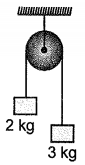
The acceleration of the system is:
1. \(1~\text{m/s}^2\)
2. \(2~\text{m/s}^2\)
3. \(1.5~\text{m/s}^2\)
4. \(0.5~\text{m/s}^2\)


Two masses as shown are suspended from a massless pulley. What would be the acceleration of the system when masses are left free?

1. \(2g/3\)
2. \(g/3\)
3. \(g/9\)
4. \(g/7\)
(where \(g\) is the acceleration due to gravity.)
1. \(9680~\text{N}\)
2. \(11000~\text{N}\)
3. \(1200~\text{N}\)
4. \(8600~\text{N}\)
If force \(F=500-100t,\) then the function of impulse with time will be:
1. \( 500 t-50 t^2 \)
2. \( 50 t-10 \)
3. \( 50-t^2 \)
4. \( 100 t^2\)
| Column-I | Column-II | ||
| (A) | Elevator moving at constant speed | (I) | Force on the floor by the person \(=600\) N |
| (B) | Elevator accelerating upward at \(3~\text{ms}^{-2}\) | (II) | Force on the floor by the person \(=780\) N |
| (C) | Elevator accelerating downward at \(3~\text{ms}^{-2}\) | (III) | Force on the floor by the person \(=420\) N |
| 1. | \(\mathrm{A\text-I,B\text-II,C\text-III}\) | 2. | \(\mathrm{A\text-II,B\text-I,C\text-III}\) |
| 3. | \(\mathrm{A\text-III,B\text-I,C\text-II}\) | 4. | \(\mathrm{A\text-III,B\text-II,C\text-I}\) |
A person standing on a spring balance inside a stationary lift measures \(60~\text{kg}\). The weight (in N) of that person if the lift descends with the uniform downward acceleration of \(1.8~\text{m/s}^2\) will be: [\(g=10~\text{m/s}^2\)]
1. \(600~\text{N}\)
2. \(500~\text{N}\)
3. \(492~\text{N}\)
4. \(450~\text{N}\)

1. 3
2. 6
3. 5
4. 4
A person of mass 60 kg is inside a lift of mass 940 kg and presses the button on control panel. The lift starts moving upwards with an acceleration . If , the tension in the supporting cable is:
1. 9680 N
2. 11000 N
3. 1200 N
4. 8600 N
Pulley and strings shown in the figure are massless. Acceleration of 3 kg block is: [Take g = 10 ]
(1) 1
(2) 2
(3) 3
(4) 4
The motion of a particle of mass \(m\) is described by \(y=ut+\frac{1}{2}gt^{2}.\) The force acting on the particle is:
1. \(3mg\)
2. \(mg\)
3. \(\frac{mg}{2}\)
4. \(2mg\)

© 2026 GoodEd Technologies Pvt. Ltd.