
 Q. No.
Two small spheres each carrying a charge q are placed r meter apart. If one of the spheres is taken around the other one in a circular path of radius r, the work done will be equal to
1. Force between them × r
2. Force between them × 2πr
3. Force between them / 2πr
4. Zero


If a unit positive charge is taken from one point to another over an equipotential surface, then -
1. Work is done on the charge
2. Work is done by the charge
3. Work done is constant
4. No work is done
In the electric field of a point charge q, a certain charge is carried from point A to B, C, D and E. Then the work done
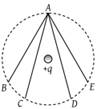
1. Is least along the path AB
2. Is least along the path AD
3. Is zero along all the paths AB, AC, AD and AE
4. Is least along AE
On rotating a point charge having a charge \(q\) around a charge \(Q\) in a circle of radius \(r,\) the work done will be:
| 1. | \(q \times2 \pi r\) | 2. | \(q \times2 \pi Q \over r\) |
| 3. | zero | 4. | \(Q \over 2\varepsilon_0r\) |
| 1. | The electric potential at the surface of the cube is zero. |
| 2. | The electric potential within the cube is zero. |
| 3. | The electric field is normal to the surface of the cube. |
| 4. | The electric field varies within the cube. |
Equipotential surfaces associated with an electric field which is increasing in magnitude along the x-direction are
1. Planes parallel to yz-plane
2. Planes parallel to xy-plane
3. Planes parallel to xz-plane
4. Coaxial cylinders of increasing radii around the x-axis

In a certain charge distribution, all points having zero potential can be joined by a circle \(S.\) The points inside \(S\) have positive potential, and points outside \(S\) have a negative potential. A positive charge, which is free to move, is placed inside \(S.\) What is the correct statement about \(S\):
| 1. | It will remain in equilibrium |
| 2. | It can move inside \(S,\) but it cannot cross \(S\) |
| 3. | It must cross \(S\) at some time |
| 4. | It may move, but will ultimately return to its starting point |
The diagrams below show regions of equipotentials.

| 1. | the maximum work is required to move \(q\) in figure(iii). |
| 2. | in all four cases, the work done is the same. |
| 3. | the minimum work is required to move \(q\) in the figure(i). |
| 4. | the maximum work is required to move \(q\) in figure(ii). |
Assertion : Potential difference between two points lying in a uniform electric field may be equal
to zero.
Reason : Points of line normal to electric field is equipotential line.
- If both the assertion and the reason are true and the reason is a correct explanation of the assertion
- If both the assertion and reason are true but the reason is not a correct explanation of the assertion
- If the assertion is true but the reason is false
- If both the assertion and reason are false
Assertion : Two equipotential surfaces cannot cut each other.
Reason : Two equipotential surfaces are parallel to each other.
- If both the assertion and the reason are true and the reason is a correct explanation of the assertion
- If both the assertion and reason are true but the reason is not a correct explanation of the assertion
- If the assertion is true but the reason is false
- If both the assertion and reason are false

© 2026 GoodEd Technologies Pvt. Ltd.